

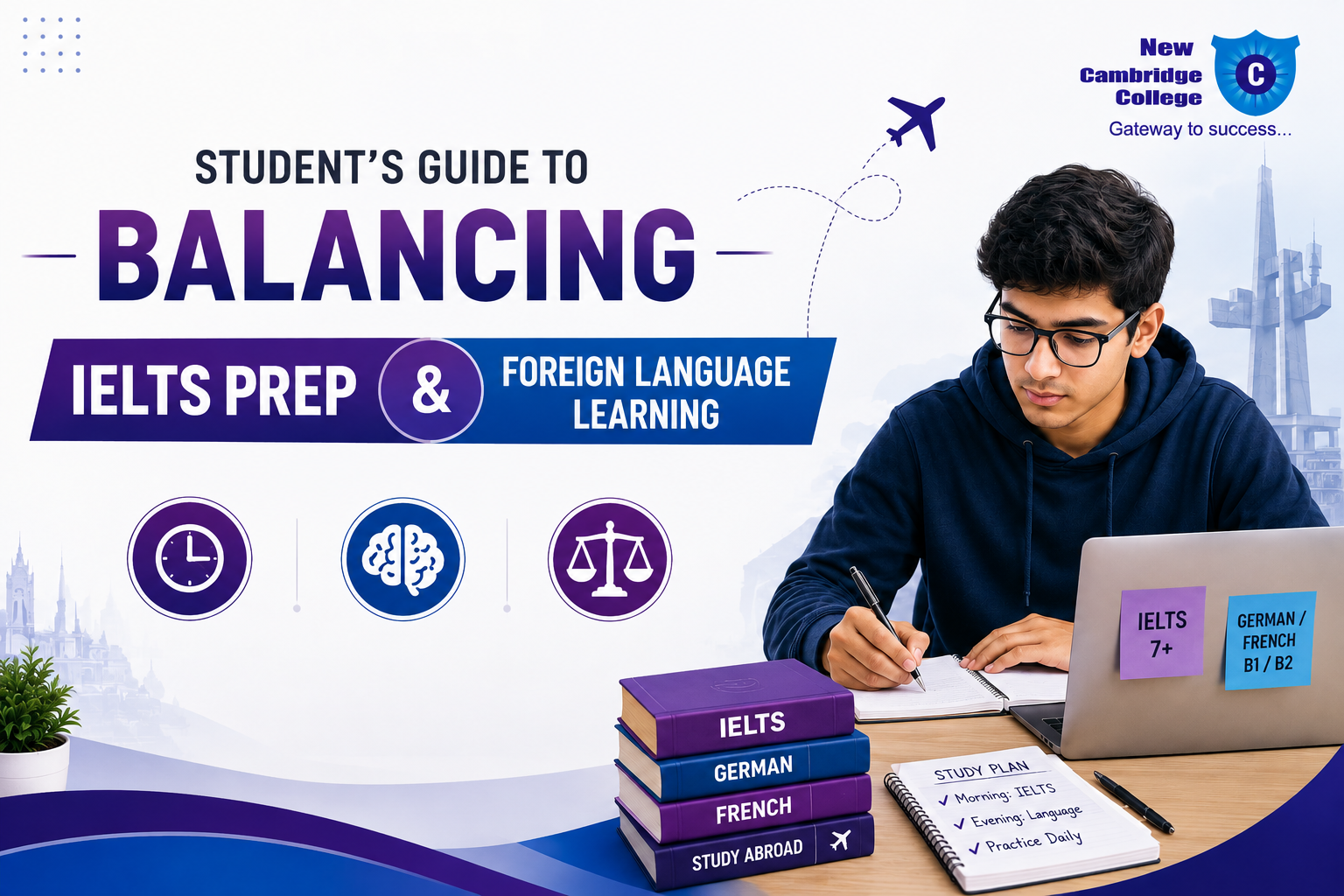
Why Chandigarh Students Often Need Both
Chandigarh has become one of North India’s biggest hubs for study-abroad preparation, and increasingly, that preparation isn’t just about English anymore. Students heading to Germany for a bachelor’s or master’s degree often need German up to B1/B2 level (even for English-taught programs, since it helps with part-time jobs, daily life, and PR pathways). Similarly, French is increasingly required or strongly recommended for Quebec-bound Canadian applicants and French university programs. At the same time, IELTS remains non-negotiable for the visa itself, for university admission, and in Canada’s case for Express Entry and PR points under systems like CRS. So the question isn’t IELTS or German/French — it’s how to run both prep tracks without one sabotaging the other.The Core Problem: Cognitive Interference
The biggest risk when learning two languages simultaneously isn’t time — it’s cognitive interference, where your brain starts blending grammar rules, sentence structures, or vocabulary between the two languages. This is especially true early in language learning, when neural pathways for the new language are still fragile and your brain instinctively reaches for whatever linguistic pattern is more dominant at that moment. The good news: interference is manageable, and in most cases entirely avoidable, if you structure your learning correctly. The key lies in separation — of time, of mental mode, and of study technique.Framework 1: Time-Block, Don’t Time-Share
The single biggest mistake students make is switching between IELTS and German/French prep within the same study session — doing 20 minutes of IELTS reading, then jumping to German vocabulary, then back again. This maximizes interference and minimizes retention for both. Instead, use dedicated time blocks:- Morning block (high focus hours): Assign this to whichever skill needs more cognitive heavy-lifting that week — usually IELTS Writing or Speaking practice, or new German/French grammar concepts.
- Evening block: Use for the other language, ideally with a different mode of study — listening practice, flashcards, or conversation practice rather than intensive grammar work, since your mental energy is naturally lower by then.
- Buffer of at least 30–45 minutes between blocks. Use this to physically switch environments — a short walk, a different room, even different music. This “reset” genuinely reduces cross-language interference, and it’s a technique language coaches at institutes across Chandigarh’s Sector 34 and Sector 17 hubs frequently recommend to students juggling both.
Framework 2: Match the Skill Type to the Right Language
Rather than treating both languages as identical tasks, split your study by skill type and assign each language its stronger use-case in your week:| Skill | Best Paired With |
| Reading comprehension | IELTS (transferable to real test format) |
| Listening practice | Either — but keep sessions single-language, never mixed audio |
| Grammar drilling | German/French (foundational, needs undivided focus) |
| Speaking/conversation | Both, but on alternating days, not the same day |
| Writing practice | IELTS (task-specific formats need dedicated repetition) |
Framework 3: The 60/40 Rule as Deadlines Approach
Your ratio of IELTS-to-language study time should shift based on which deadline is closer:- 8+ weeks before IELTS test date: 40% IELTS / 60% German or French — build the language foundation while IELTS stays in maintenance mode (light practice tests, vocabulary).
- 4–8 weeks before IELTS: 60% IELTS / 40% language — intensify test-specific strategy, mock tests, and timed practice.
- Final 2 weeks before IELTS: 80% IELTS / 20% language (maintenance only — don’t stop the second language entirely, or you’ll lose momentum built over months).
- After IELTS is done: Shift back to 80–90% language focus if you still have runway before your visa or program’s language deadline.
Avoiding Burnout: What Actually Works
Balancing two intensive prep tracks on top of college or work is genuinely demanding, and burnout is the most common reason students abandon one track (usually the language) halfway through. A few things make a measurable difference:- Protect one full day off per week from both languages. Not “light review” — actually off. Language acquisition (unlike IELTS test-taking skill) benefits significantly from consolidation time where you’re not actively studying.
- Track progress, not hours. Logging hours studied creates a false sense of productivity. Track band score improvements and CEFR-level milestones (A1 → A2 → B1) instead — it’s more motivating and more accurate.
- Use immersion for the language, not just classes. German/French shows, music, or even changing your phone’s language settings adds passive exposure without adding “study time” to your day — genuinely useful when your schedule is already full.
- Don’t chase both tests in the same month. If you have any flexibility, stagger your IELTS exam date and your German/French certification exam (Goethe-Zertifikat, TestDaF, DELF/DALF) by at least 4–6 weeks. Back-to-back exams in different languages within the same fortnight is one of the most common (and avoidable) causes of underperformance in both.
- Get your timeline mapped professionally. Because visa and application deadlines vary by country and intake, working backward from your target intake — rather than studying reactively — makes the whole process far less stressful. This is exactly the kind of planning that structured guidance, like the counseling and coaching support available through New Cambridge College, is built around, since it accounts for both the English proficiency requirement and the language-specific deadlines together rather than treating them as separate problems.
A Sample Weekly Structure
Here’s what a realistic week can look like for a student targeting both IELTS and German B1, roughly 10-12 weeks out from their IELTS date:| Day | Morning (60–75 min) | Evening (45–60 min) |
| Mon | IELTS Reading practice | German grammar (new topic) |
| Tue | German vocabulary + flashcards | IELTS Listening test |
| Wed | IELTS Writing Task 2 | German speaking practice (partner/app) |
| Thu | German grammar review | IELTS Speaking (mock, recorded) |
| Fri | IELTS full mock (alternate weeks) | German listening (podcast/show) |
| Sat | German grammar + writing | Light IELTS vocabulary review |
| Sun | Off (or passive immersion only) | Off (or passive immersion only) |