
- Tuition & Costs
- University Rankings
- Visa & Work Rights
- Job Prospects
📋 What’s Inside
- The FIFA Connection
- Tuition & Living Costs
- University Rankings
- Visa & Work Rights
- Language & Student Life
- Career & Job Prospects
- Scholarships
- The Final Verdict
The Money Match: Who Gives You Better Value?
In football, the team with the best budget doesn’t always win. But when choosing where to study abroad, your financial runway matters enormously. Let’s look at the real numbers. €0 Tuition at most German public universities (even for non-EU students) €170 Annual tuition at French public universities (EU students) €2,800 Average annual non-EU tuition at French public universities (post-2019)Germany — The Budget Champion
- Most public universities charge €0 in tuition for all nationalities
- Semester fees of €150–€400 include public transport passes
- Munich and Frankfurt are costlier; eastern cities like Leipzig cost less
- Average monthly expenses: €850–€1,200
- Student accommodation widely available at €300–€600/month
France — Affordable But Rising
- Non-EU students pay €2,770 (undergrad) and €3,770 (masters) at public universities
- Grandes Écoles like HEC can charge €15,000–€20,000/year
- Paris is significantly more expensive than other cities
- Average monthly expenses: €1,000–€1,800
- CAF housing subsidies can reduce rent by €80–€200/month
University Rankings: Who Has the Stronger Starting XI?
Both Germany and France field some genuinely world-class institutions. Think of it like picking a squad — both nations have elite clubs, but the depth and style of play differ.| Country | Top German Universities | Top French Universities |
| QS Rank #1 | TU Munich (#37 globally) | PSL Research University (#24 globally) |
| Strengths | Engineering, Sciences, Research output | Arts, Humanities, Business, Sciences |
| Unique Feature | Excellence Initiative — 57 elite research universities | Grandes Écoles system for elite professionals |
| English Programs | Growing — especially at masters level | Widely available across disciplines |
| Business Schools | Mannheim, Frankfurt School | HEC Paris, INSEAD, ESSEC |
The Visa Duel: Getting In and Staying On
A great degree means nothing if you can’t stay to use it. Both countries offer student visas and post-study opportunities — but the rules differ. Getting expert visa guidance early is crucial to avoid delays.Germany Visa Highlights
- Student visa (Section 16b) issued for the full course duration
- Work up to 120 full days or 240 half-days per year
- 18-month Job Seeker Visa after graduation to find work
- EU Blue Card pathway for high-skilled graduates
- Relatively straightforward application for most nationalities
France Visa Highlights
- Student visa (VLS-TS étudiant) — multi-entry, valid for the year
- Work up to 964 hours per year (≈20 hrs/week)
- 12-month APS (temporary residence permit) post-graduation
- Strong pathways via the Talent Passport for skilled workers
- France-Alumni network provides employer connections
Home Away From Home: Language, Life & Culture
Student life isn’t just about academics. Culture, social life, and how quickly you settle in matters just as much. Both countries have vibrant student communities, but the experience is quite different.Germany Student Life
- German proficiency required for most bachelor’s programmes
- Growing number of English-taught master’s programmes
- Efficient, organised, punctual culture — reassuring for many students
- Berlin, Munich & Hamburg offer world-class nightlife and arts scenes
- Excellent public transport, cycling culture
- Strong student union (AStA) support systems
France Student Life
- French is still dominant at undergrad level — learning it is a big plus
- Many top schools offer full English-taught programmes
- Paris ranks consistently as one of the world’s best student cities
- French cuisine, art, fashion, and philosophy form a rich cultural backdrop
- Strong café culture promotes discussion and creativity
- Student discounts everywhere — cinema, transport, museums
Post-Grad Jobs: Who Scores After the Final Whistle?
The real test of a degree is what happens when you leave campus. Both Germany and France have strong economies — but they attract different types of graduates. Thinking long-term? Our advisors can help you align your study destination with your career goals. 4tGermany’s rank in world economy (GDP, 2024) 7th France’s rank in world economy (GDP, 2024) €45–60k Average starting salary for engineering/tech graduates in Germany| Sector | Germany | France |
| Engineering & Manufacturing | World-leading (BMW, Siemens, BASF, SAP) | Strong (Airbus, Renault, Alstom) |
| Finance & Business | Frankfurt is Europe’s banking hub post-Brexit | Paris is #1 financial centre in the EU |
| Luxury & Fashion | Limited | Global hub — LVMH, L’Oréal, Chanel |
| Startups & Tech | Berlin is Europe’s fastest-growing tech city | Paris “Station F” — world’s largest startup campus |
| Healthcare & Pharma | Excellent — Bayer, Boehringer Ingelheim | Strong — Sanofi, Institut Pasteur |
Scholarships: Free Kicks for Your Future
Beyond tuition, both countries offer substantial scholarship opportunities for international students. Here’s a quick breakdown of key programmes to explore:Germany Scholarships
- DAAD (German Academic Exchange Service) — largest scholarship provider globally for international students in Germany
- Deutschlandstipendium — €300/month, merit-based
- Heinrich Böll Foundation scholarships for social justice focus
- Konrad Adenauer Stiftung for political science and social sciences
- Many universities offer institutional merit scholarships
France Scholarships
- Eiffel Excellence Scholarship — French government programme for outstanding non-EU students
- BGF (French Embassy scholarships) available in most countries
- Émile Boutmy Scholarship at Sciences Po
- HEC Paris Merit Scholarships for MBA and Masters
- Campus France coordinates most funding searches
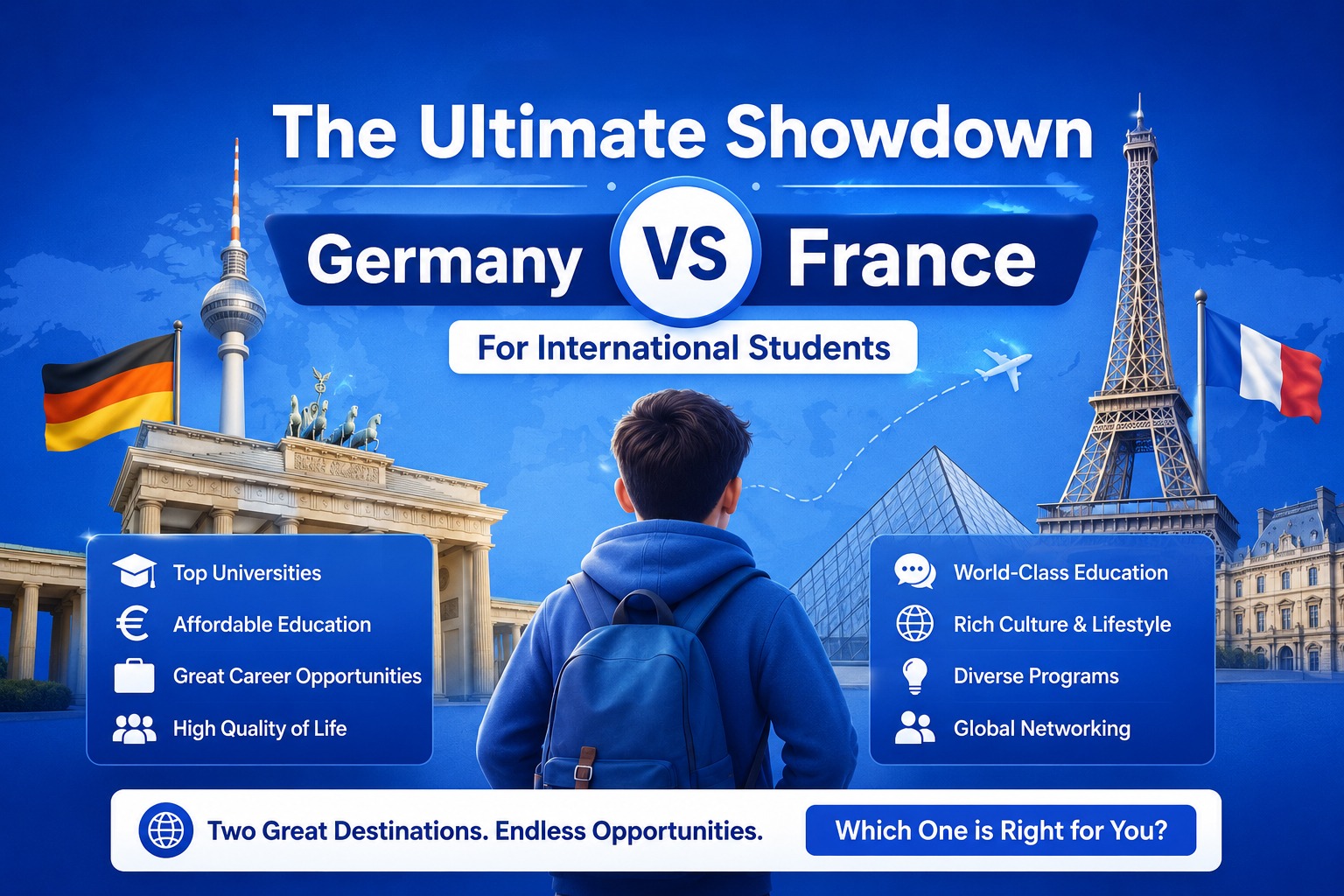
Germany vs France: Who Wins the Education World Cup?
Like any great football match, there’s no clear winner — it comes down to what you’re looking for. Here’s our final scorecard:🏆 Final Scorecard 2026
Affordability (Germany) Prestige (Both) Post-Study Visa (Germany) English Programs (France) Student Life (Both) Engineering/Tech Jobs (Germany) Business/Luxury Jobs (France) Scholarships (Both) Choose Germany If You…- Want zero or near-zero tuition at a world-class university
- Are pursuing engineering, sciences, or technology
- Want the longest post-study job search window (18 months)
- Prefer a structured, efficient living environment
- Are open to learning German alongside your studies
Choose France If You…
- Are targeting business, finance, arts, or luxury management
- Want access to globally ranked Grandes Écoles
- Crave the cultural richness and prestige of Paris
- Want to learn French — one of the world’s most useful languages
- Are aiming for international organisations or diplomacy